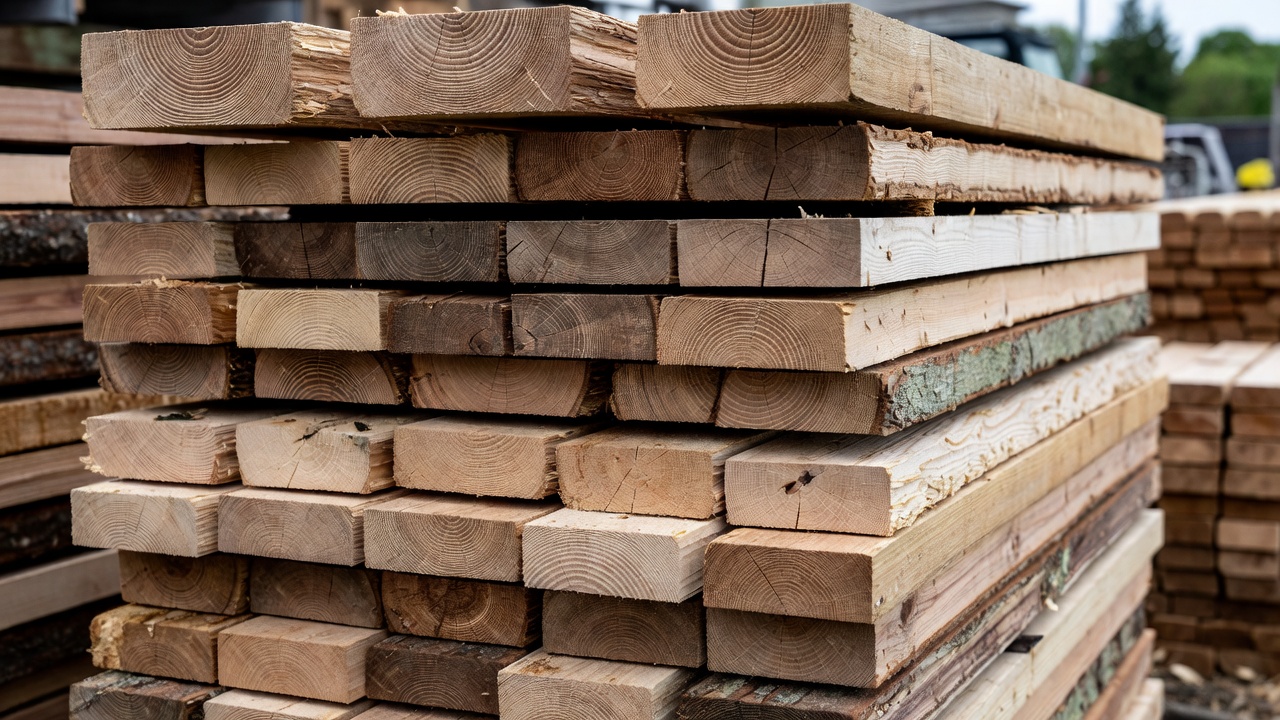
Wood is renewable within a living forest system, but renewability does not make every harvest or product environmentally equivalent. Forest management affects habitats, soils, water and future growing conditions. Ownership, local livelihoods and land-use rights also belong in the discussion. The label “natural” addresses none of these questions by itself, and the appearance of a board cannot establish its origin.
Start with the material that is actually being supplied. Species, country or region of origin, supplier identity and the relevant sourcing documentation should connect to the order rather than merely to a company's general marketing. An appealing story about nearby forests is not the same as a traceable claim about a particular batch of timber.
Understand what certification answers
The Forest Stewardship Council, or FSC, and the Programme for the Endorsement of Forest Certification, or PEFC, operate certification systems addressing forest management and supply-chain claims. Chain-of-custody certification concerns how certified claims are controlled through processing and trade. The exact claim matters: different product labels and sourcing categories should not be treated as identical.
Certification can provide useful evidence, but it does not establish that a building has low whole-life carbon, that every ecological impact is absent, or that a particular product is suitable for structural use. Check the scope and validity of the certificate and the wording on the transaction documents. Where sensitive sourcing questions arise, further due diligence may be necessary.
Read environmental declarations carefully
An environmental product declaration, or EPD, reports quantified environmental information using defined rules. EN 15804 provides core rules for construction-product declarations in the European context. An EPD is not a universal green approval stamp. Its usefulness depends on reading the product description, declared unit, assessed life-cycle modules and underlying assumptions.
Comparisons become misleading when one product is assessed per unit of mass and another per functional assembly, or when different stages are included. A floor is not interchangeable with a kilogram of wood: it must provide a span, loading capacity, acoustic performance and service life. Meaningful comparison begins by making the required function and the assessment boundaries equivalent.
| Evidence | Useful for asking | Does not establish alone |
|---|---|---|
| Sourcing and chain-of-custody records | How is the supplied product's sourcing claim documented? | Whole-building carbon performance or structural suitability. |
| Environmental product declaration | What impacts are reported within the stated boundaries? | That the product is the best option for every use. |
| Technical product documentation | What properties and intended applications are declared? | Responsible forest management or a repair strategy. |
| Inspection and maintenance plan | How will the assembly remain serviceable? | A guaranteed lifespan under all future conditions. |
Stored carbon needs a time frame
Trees take up carbon as they grow, and wood products can retain part of that carbon during use. The wider climate account also involves harvesting, processing, transport, replacement and end-of-life treatment. Regrowth and the alternative trajectory of a forest introduce further questions. Calling a product “carbon negative” without explaining the method can conceal more than it reveals.
Building-level methods, including the framework addressed by EN 15978, help organise assessment across life-cycle stages. They still require scenarios and project-specific data. A long service life and actual reuse may support a favourable outcome, but assumed future reuse is not the same as an existing recovery route. Report these possibilities as scenarios rather than guaranteed credits.
Durability is a design decision
Good environmental intentions can be undermined by a short-lived detail. Timber kept wet at a concealed junction may require early replacement, taking labour, finishes and adjacent materials with it. Species selection is one part of durability, but drainage, drying potential, exposure and maintenance are equally important. A durable assembly is a relationship among materials and conditions, not a species name alone.
Treatments and coatings also deserve specific questions. What hazard are they addressing? What maintenance interval is assumed? Will they affect indoor use, handling or future recycling? Untreated wood is not automatically appropriate, and a treated product is not automatically irresponsible. Suitability depends on the use class, the product and the exposure being designed for.
Reuse starts before disassembly
Recovered timber can preserve material value, but assessment remains necessary. Previous loading, hidden damage, fastener holes, coatings and uncertain provenance may restrict its next use. A reclaimed beam's character does not establish its residual structural capacity. Appropriate inspection, grading or engineering assessment may be required before it returns to a load-bearing role.
New buildings can make future recovery easier through accessible connections, separable layers and good records. Adhesives, composite build-ups and inaccessible fixings may complicate that ambition. Design for disassembly is therefore more useful when it identifies a realistic sequence, tools and destination for recovered components rather than relying on a general promise of circularity.
A better brief for a supplier
- Define the use. State exposure, performance requirements and the intended service environment.
- Request traceable evidence. Connect sourcing claims and technical documents to the actual supply.
- Compare equivalent functions. Align units, life-cycle boundaries and replacement assumptions.
- Plan the next life. Record inspection access, maintenance needs and realistic recovery options.
Responsible material decisions are rarely resolved by one badge or one number. They become clearer when evidence, limits and practical detailing are discussed together.