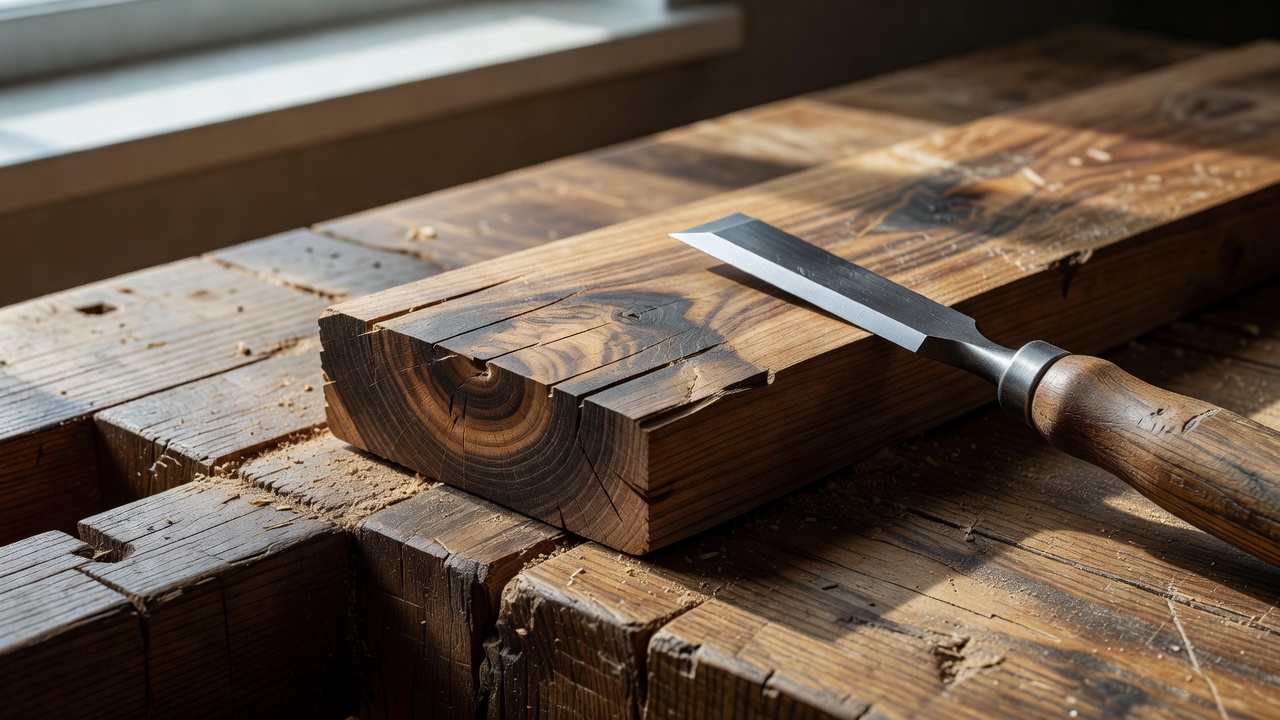
Wood has direction. Its strength, shrinkage and response to cutting vary with the orientation of its fibres. A joint that looks generous in outline may leave a vulnerable short-grain section at a notch. A clean shoulder may carry bearing well in one arrangement and poorly in another. Reading joinery begins by following the grain through the connection, not by admiring complexity alone.
Species matters, but so do growth characteristics, knots, moisture condition and the chosen part of a tree. Pine and spruce appear widely in northern building, yet neither is a single predictable substance. Structural grading and assessment belong to the actual material and its intended use. The familiar language of “good timber” is not a replacement for those checks.
Marks record actions, not just appearance
An axe can produce a faceted surface; a plane can leave long, controlled passes; a saw establishes a kerf with its own texture. Yet later finishing, weathering and repair may change the evidence. Machine processing can also imitate a hand-worked appearance. A careful reader considers several clues together and avoids assigning an exact tool, maker or century from one photograph.
Layout marks can be particularly revealing. Lines, assembly marks and small reference cuts may explain how pieces were oriented or paired. Some survive in places never intended for display. Their value lies in the working process they disclose. Scrubbing or sanding them away in pursuit of a uniformly clean surface can remove useful information from an old structure.
What a mortise and tenon explains
At its simplest, a tenon projects from one member into a corresponding mortise in another. Shoulders, cheeks and bearing faces influence how the assembly locates and transfers forces. A peg may help retain a connection, but its role depends on the detailed design. A rectangular sketch cannot establish capacity, allowable dimensions or suitability for a real building.
There is no rule that an older-looking joint is stronger, greener or more appropriate. A connection must answer a load case, an assembly method and a service environment. Traditional joinery can provide valuable lessons in replaceability and material economy, while modern metal connectors can solve problems that would otherwise require larger sections. Both deserve examination rather than automatic approval.
Scribing and the fitted log
Scribing transfers the form of one irregular surface to another. In log work, this can help create a close relationship between members whose shapes are not identical. It is a method of dealing with real timber rather than assuming perfectly interchangeable components. Regional corner forms and individual workshop methods differ, so one illustrated notch should never be presented as the Norwegian or Finnish joint.
Fitting is also temporal. A joint is cut and assembled at a particular moisture condition, then experiences drying and seasonal change. Restraining that movement without understanding it may open gaps elsewhere or introduce damage. This is why observing a finished joint is only part of learning: the sequence, the state of the material and the building's later behaviour all matter.
Urnes Stave Church in Norway and Petäjävesi Old Church in Finland are distinct UNESCO-listed timber monuments. Neither should be used as a generic diagram of domestic construction.
Craft knowledge includes restraint
Norwegian stave churches, including Borgund and Urnes, draw attention to framed timber construction and highly particular histories. Their survival does not mean exposed timber is maintenance-free. Roof coverings, moisture management, conservation decisions and repairs belong to that survival. It is more useful to study these conditions than to turn a historic monument into a slogan about timeless natural durability.
Repair work asks a different question from new fabrication: how much intervention is necessary? A splice may conserve sound material, but it introduces a new connection with its own demands. Consolidation, replacement and protective changes each need a reason. The best-looking solution in a close-up photograph may not be the safest or most historically appropriate one in context.
A sequence for looking, not building
- Find the fibres. Notice grain direction, knots and any interrupted sections near the joint.
- Identify the references. Look for shoulders, bearing faces and marks used to locate the pieces.
- Imagine assembly. Ask which member must arrive first and how a repair might later be made.
- Ask about movement. Consider moisture change, settlement and the places where restraint occurs.
This is a vocabulary for informed observation, not a substitute for supervised craft training or structural design. Sharp tools, heavy members and load-bearing connections demand appropriate skills, equipment and professional judgement.